
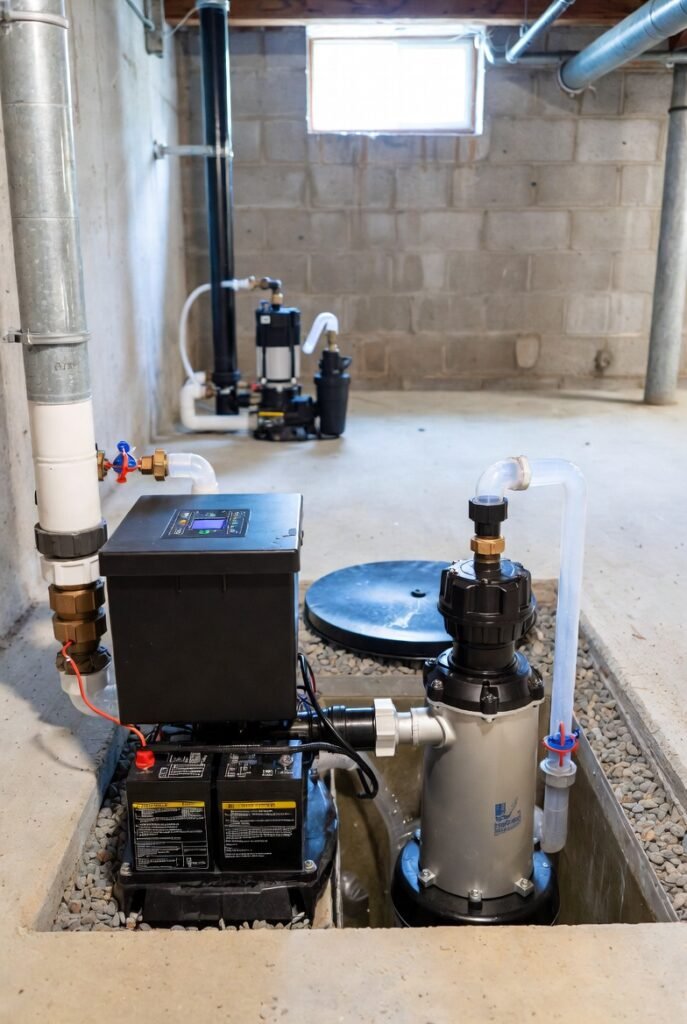
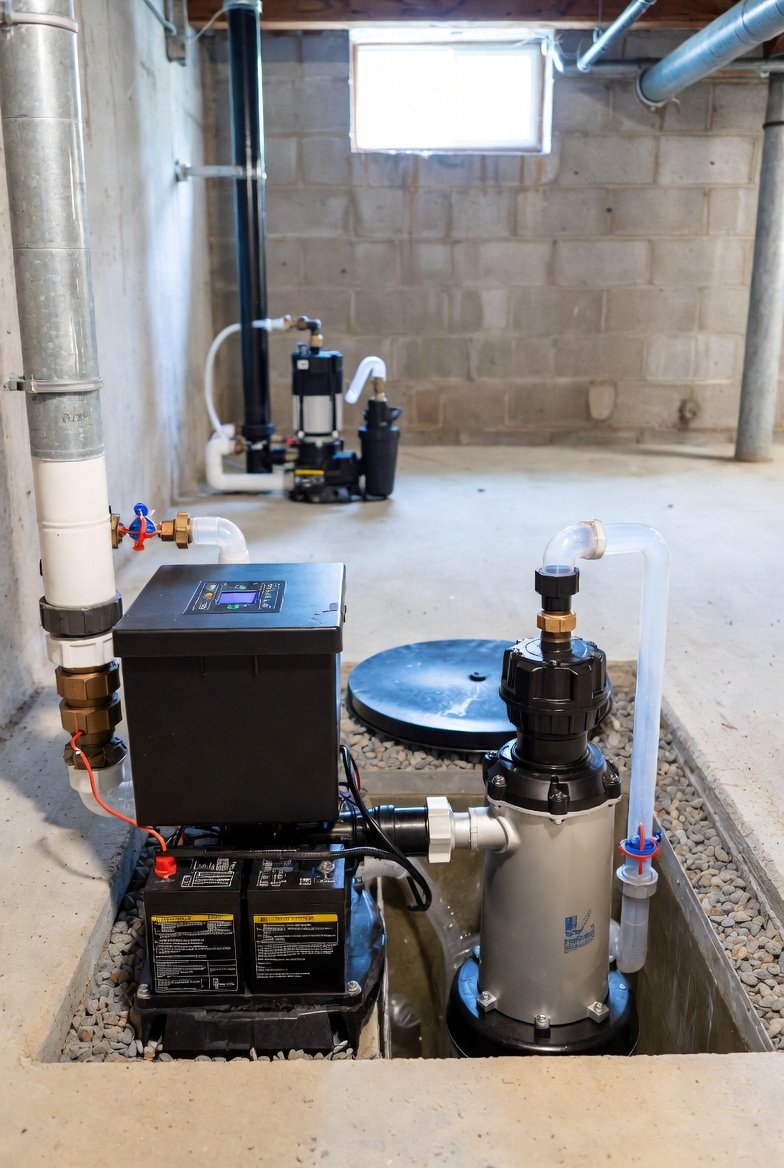
Battery Backup Sump Pump Installation
Storm hits.
Power drops.
Your primary sump pump goes silent.
That 30–60 minute outage is enough to flood a finished basement.
Most homeowners assume:
“I have a sump pump — I’m protected.”
That’s only true when electricity is flowing.
A battery backup sump pump installation removes the single biggest failure point in basement flood protection: power loss during peak storm load.
This guide covers:
- The two real battery backup architectures (and which one you actually need)
- Pit size and float placement rules that prevent backup failure
- Shared vs separate discharge logic
- A realistic runtime calculator (not marketing promises)
- Alarm systems and monitoring
- Maintenance discipline and battery replacement
- When battery backup is not enough
If your primary pump system isn’t optimized yet, review:
👉basement-sump-pump-installation
Backup only works when the base system works.
Understanding the Two Battery Backup Architectures
There is confusion in the SERP around this topic. Let’s separate them cleanly.
1️⃣ Battery Inverter / Controller (Powers Your Primary AC Pump)
How it works:
- Battery feeds inverter
- Inverter powers your existing AC sump pump during outage
Best for:
- Newer primary pumps
- Moderate water load
- Areas with short outages
Limitation:
If the primary pump motor fails mechanically, you still flood.
2️⃣ Dedicated DC Backup Pump (True Redundancy System)
This installs:
- A secondary DC pump inside the same pit
- A separate float switch (mounted higher than primary)
- A battery + charging controller
This protects against:
- Power failure
- Primary pump burnout
- Float failure
- Overload events
For finished basements, this is usually the superior configuration.
Backup System Decision Table
Your Situation | Recommended Setup |
Rare short outages | Inverter/controller |
Heavy water load | Dedicated DC backup pump |
Finished basement | Dedicated DC backup |
Older unreliable primary pump | Dedicated DC backup |
Want true redundancy | Dedicated DC backup |
Pit Fit & Float Placement (Most Common Failure Point)
Backup failure often happens because:
- Floats collide
- Pumps interfere
- Basin too small
- Discharge pipe blocks float movement
Critical Float Rule
The backup float must activate after the primary float.
Mount it slightly higher than the primary’s “on” level.
If both floats activate simultaneously:
- Pumps compete
- Water turbulence increases
- Short cycling happens
Pit Fit Checklist
- Basin diameter large enough for two pumps
- Both pumps sit flat
- No discharge pipe blocking float movement
- Minimum clearance around float arm
- Wiring secured above water line
If pit is undersized → upgrade basin before installing backup.
Do not force two pumps into a cramped sump.
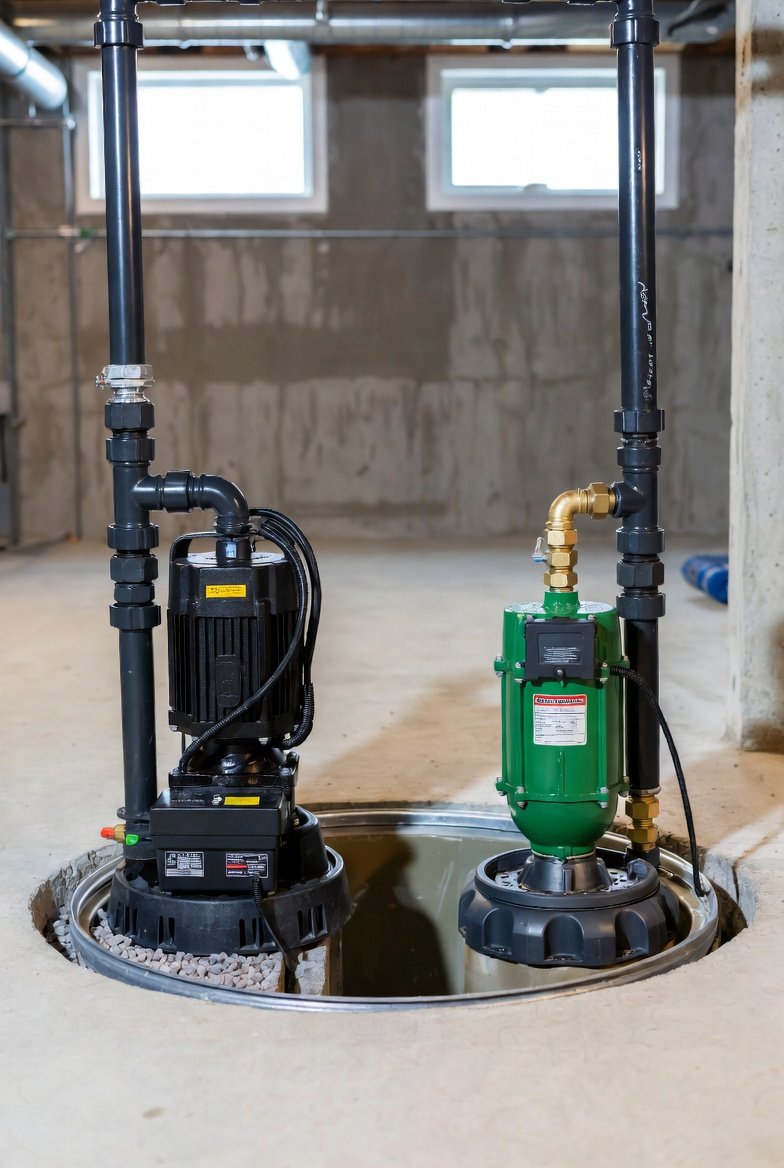
Shared vs Separate Discharge Line (Engineering Decision)
Option A: Shared Discharge
Common method.
Requirements:
- Each pump has its own check valve
- Proper vertical spacing between valves
- Secure pipe support
Risk:
If discharge line freezes or clogs, both pumps fail.
Building science guidance emphasizes directing discharge away from the foundation to prevent water recycling. (Building America Solution Center, PNNL)
Option B: Separate Discharge (Higher Reliability)
Each pump:
- Has independent exit
- Cannot be disabled by shared blockage
Best for:
- High flood-risk homes
- Areas with freeze-prone discharge lines
If your discharge routing isn’t optimized, review:
👉basement-drainage-system
Battery Sizing & Runtime Calculator (Realistic Planning)
This is where most homeowners misunderstand protection.
Step 1: Estimate Pump Power
Example:
- Backup pump draws 10 amps at 12V
- Power = 120 watts
Step 2: Battery Capacity
Example battery:
- 12V, 100Ah
Watt-hours = 12 × 100 = 1200Wh
But usable energy (lead-acid) ≈ 50–60%
→ Usable ≈ 600–700Wh
Step 3: Runtime Estimate
If pump draws 120W continuously:
600Wh ÷ 120W = ~5 hours theoretical
Real-world runtime depends on:
- Duty cycle (pump doesn’t run 100% continuously)
- Head height
- Inverter losses (if AC-based)
Heavy inflow storms can reduce runtime significantly.
Battery backup protects against short-to-moderate outages — not multi-day continuous pumping.
If your region experiences long outages, you may need layered redundancy.
👉backup-sump-pump-installation
Battery Type Quick Guide
Type | Pros | Cons |
Flooded Lead-Acid | Affordable | Requires ventilation & maintenance |
AGM (Absorbed Glass Mat) | Sealed, lower maintenance | Higher cost |
Lithium | Lightweight, deeper discharge | Expensive, compatibility matters |
Replace batteries every 3–5 years, depending on manufacturer guidance.
High Water & Battery Alarms (Often Overlooked)
Top-tier systems include:
- High water alarm
- Battery failure alarm
- Low voltage alert
- Optional Wi-Fi/text alerts
An alarm gives you time to act before flooding.
Without one, you may not know your backup failed.
Installation Safety Best Practices
- Use dedicated, reliable outlet for charger
- Avoid extension cords
- Keep battery elevated and dry
- Protect wiring connections from moisture
- Secure cables above water level
Sump systems operate near water. Electrical discipline matters.
Quarterly Testing Protocol
- Unplug primary pump
- Fill pit with water
- Confirm backup activates
- Observe discharge
- Restore power
- Confirm charger resumes charging
Also test:
- After battery replacement
- Before storm season
Limitations (Honest Failure Planning)
Battery backup will NOT save you if:
- Discharge line is frozen or clogged
- Pit too small causes float jam
- Water inflow exceeds pump capacity
- Outage lasts longer than battery runtime
- Battery was never maintained
Redundancy removes one failure point — not all of them.
When Battery Backup Is Non-Negotiable
Strongly recommended if:
- Basement is finished
- Flood damage would exceed $10,000
- Storms regularly knock out power
- You’ve had previous sump failures
For emergency response planning:
👉water-leak-emergency
For cleanup cost awareness:
👉basement-flood-cleanup-cost
Final Verdict
Battery backup sump pump installation is about eliminating single points of failure.
Primary pump = normal conditions.
Battery backup = outage protection.
Installed correctly, tested quarterly, and maintained properly, it transforms your sump system from vulnerable to resilient.
Done casually, it becomes expensive false confidence.