
Interior French Drain: What It Solves — And What It Does Not
When soil surrounding a foundation becomes saturated, it does not simply “hold water.”
It builds lateral and downward hydrostatic pressure.
That pressure forces groundwater toward the base of the wall — typically the cove joint where the slab meets the foundation.
An interior French drain is not a wall sealant.
It is a pressure relief channel installed inside the basement footprint to control water once it reaches footing level.
It manages water movement.
It does not stop soil saturation.
For a full system overview, see:
Fast Definition
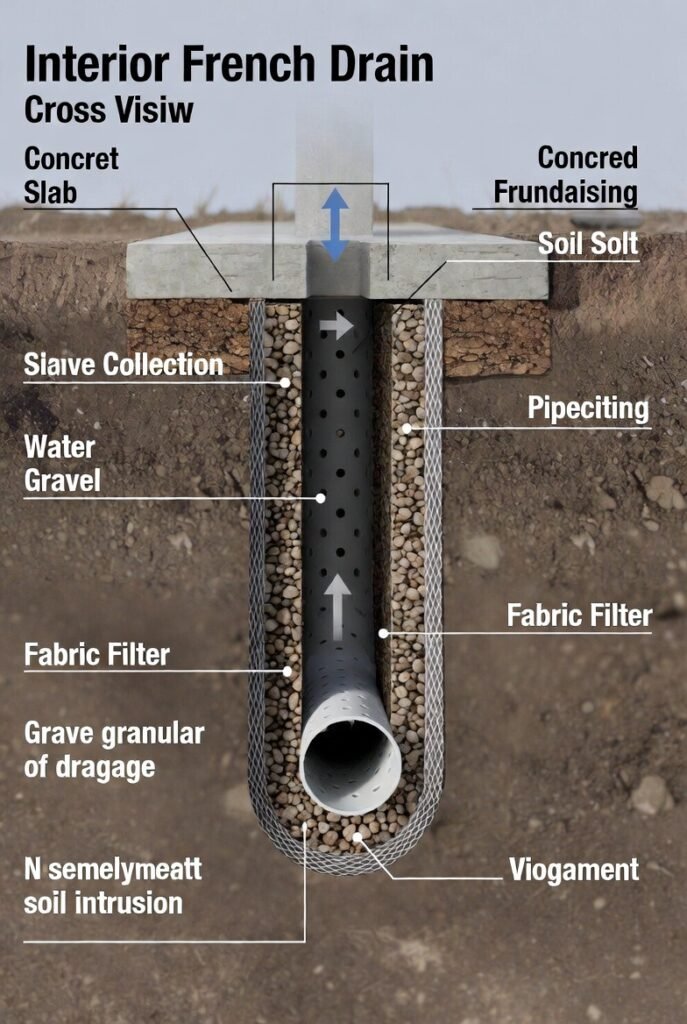
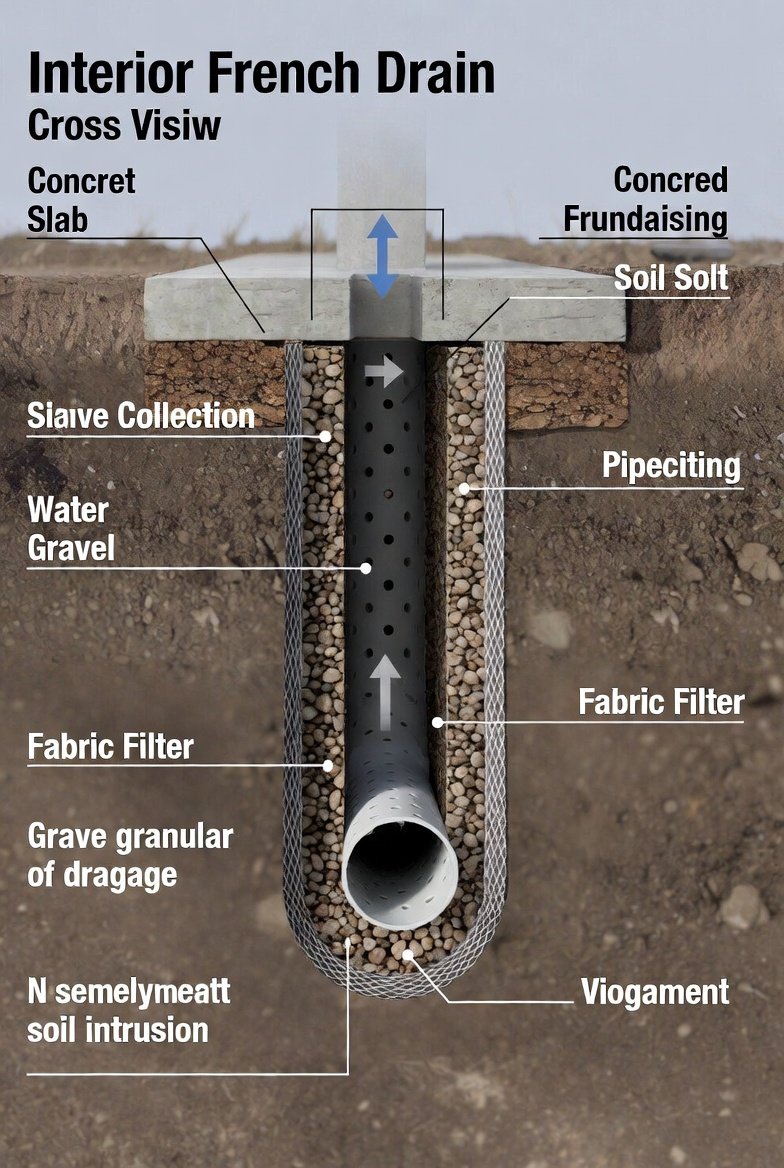
An interior French drain is a sub-slab drainage trench installed along the inside perimeter of a basement foundation wall. It collects groundwater at the footing level and directs it to a sump basin for controlled discharge.
It is often called “interior drain tile,” but its function is hydrostatic pressure management.
How Water Actually Reaches the Interior System
Understanding the mechanics matters.
- Soil becomes saturated from rainfall or snowmelt.
- Hydrostatic pressure increases against the foundation wall.
- Water migrates downward along the wall surface.
- At the cove joint (wall-to-slab seam), seepage begins.
- Sub-slab pressure forces moisture upward beneath the slab.
An interior trench intercepts that water at footing level before it spreads across the basement floor.
It does not eliminate pressure in the soil.
It creates a lower-resistance path inside the structure.
Inside Configuration: What Is Physically Installed
Typical installation includes:
- 2–4 inch concrete saw-cut along perimeter
- Trench excavated beside foundation footing
- Gravel bedding layer
- Perforated 4-inch drain pipe
- Filter fabric separation
- Sump basin integration
- Concrete restoration
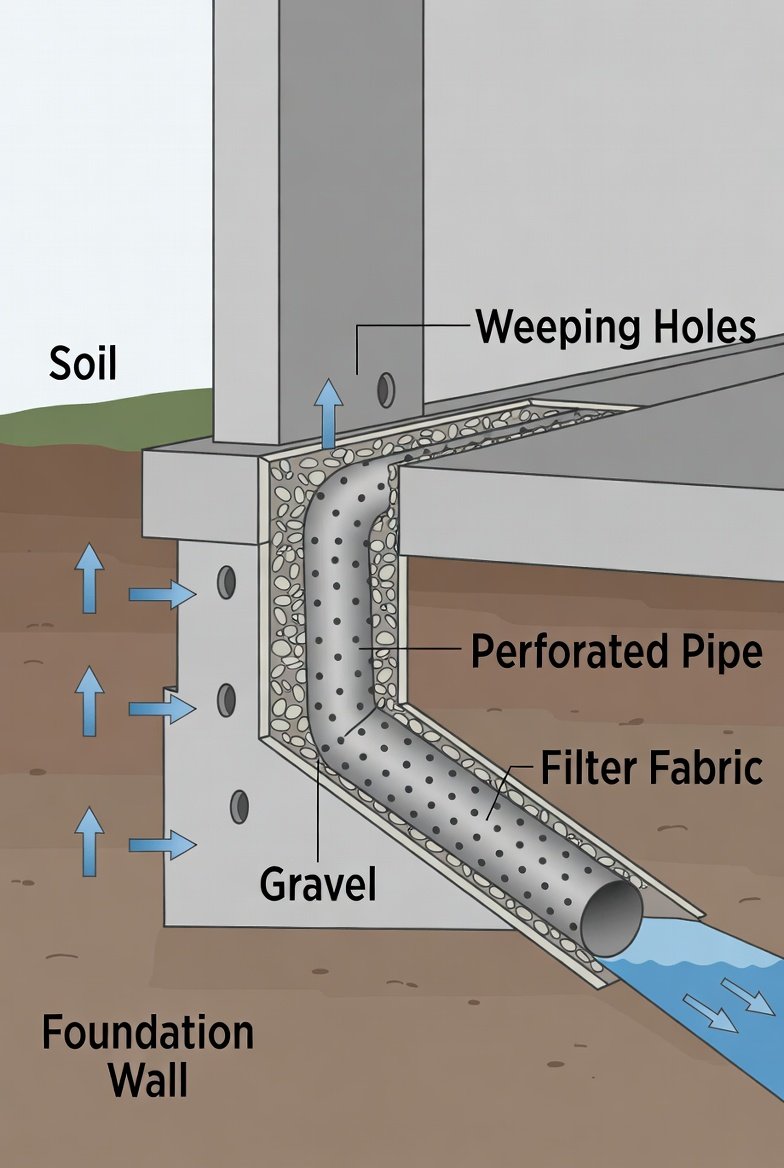
Some systems also include:
- Wall flange channel to capture wall seepage
- Dimple board to direct water downward
- Weep holes drilled into hollow block walls (when applicable)
These are configuration variations — not universal requirements — but they influence performance.
Interior vs Exterior: Structural Role Comparison
Feature | Interior French Drain | Exterior French Drain |
Intercepts water | At footing level | Before wall contact |
Excavation zone | Inside slab | Outside foundation |
Pressure relief timing | After soil saturation | Earlier interception |
Landscape impact | Minimal | High |
Waterproof membrane involvement | No | Often yes |
Sump dependency | Almost always | Sometimes |
Interior systems manage water at the base.
Exterior systems attempt to intercept water earlier in the soil column.
They solve different stages of the same water path.
Diagnostic: When Interior Drain Is the Right Move
Interior French drains are appropriate when:
✔ Water appears at the cove joint
✔ Seepage follows wall-to-floor seam
✔ Exterior excavation is impractical
✔ Urban lot restricts access
✔ Hardscape removal would be excessive
✔ Finished basement limits exterior disruption
Diagnostic triggers:
- Damp carpet edge along perimeter
- Efflorescence at slab seam
- Repeated puddling during heavy rain
- Pump pit already present but undersized
When Interior Drain Is NOT the Right First Step
Interior systems are not ideal when:
✘ Water enters mid-wall (likely crack or penetration)
✘ Foundation wall bowing exists
✘ Surface grading slopes toward house
✘ Downspouts discharge near foundation
✘ Exterior membrane failure is primary issue
In those cases, exterior correction may be required before interior channeling.
For cost context across waterproofing options:
Sump Integration: The Critical Component
Interior French drains almost always terminate in a sump basin.
Proper integration requires:
- Basin sized for expected inflow
- Sealed lid to reduce humidity release
- Check valve to prevent backflow
- Dedicated discharge line
- Minimum 1% slope toward basin
Without reliable pump discharge, the drain trench becomes a water reservoir.
For pump design details:
basement-sump-pump-installation
Backup integration logic:
battery-backup-sump-pump-installation
Storm events frequently coincide with power outages. Redundancy is not optional in high water table regions.
Failure Modes Specific to Interior Systems
Failure Mode | Root Cause | Consequence |
Sediment clogging | No fabric separation | Reduced flow |
Basin short cycling | Undersized pit | Pump burnout |
Humidity increase | Open pit lid | Mold growth |
Backflow during outage | No check valve | Basement flooding |
Discharge freeze | Exterior outlet blockage | System shutdown |
Interior drains rely on mechanical discharge.
Exterior drains rely more on gravity.
Different failure risks — different maintenance priorities.
Maintenance Protocol (Practical Checklist)
Quarterly:
- Test pump activation
- Inspect discharge outlet
Annually:
- Clean sump basin sediment
- Verify check valve operation
- Inspect backup battery (if installed)
Every 2–3 years:
- Professional channel inspection
- Confirm slope integrity
Neglected maintenance is one of the most common causes of interior system failure.
If flooding has already occurred, stabilize first:
Layered Protection Strategy
Interior French drains work best as part of layered defense:
- Exterior grading correction
- Extended downspouts
- Sump redundancy
- Separate discharge routing
- Crack repair when needed
Drainage is pressure control — not cosmetic repair.
Interior vs Exterior vs Both: Calm Verdict Matrix
Scenario | Recommended Approach |
Urban lot, limited access | Interior |
Severe exterior membrane failure | Exterior |
High water table + finished basement | Interior + sump redundancy |
New construction | Exterior primary, interior backup optional |
Recurrent cove joint seepage | Interior |
Interior systems are often practical solutions in retrofit scenarios.
Exterior systems are often stronger prevention methods during new builds.
In high-risk environments, both layers may be justified.
What This Configuration Ultimately Solves
An interior French drain:
✔ Relieves sub-slab hydrostatic pressure
✔ Captures water at footing level
✔ Directs groundwater to controlled discharge
✔ Protects interior flooring
It does not:
✘ Seal exterior foundation
✘ Replace structural repair
✘ Correct grading errors
✘ Eliminate soil saturation
Clear expectations reduce misapplication.
FAQ
What is an interior French drain?
A sub-slab perimeter drainage trench installed inside the basement to collect groundwater at the footing and direct it to a sump basin.
Does it stop water from entering the foundation?
No. It manages water once it reaches footing level but does not prevent soil saturation outside.
Do all interior drains require a sump pump?
Most do. Interior systems depend on active discharge.
How long do interior systems last?
Drain pipe may last 20–30 years. Sump pumps typically last 7–12 years depending on usage.
Can I finish my basement after installation?
Yes. Interior drains are commonly used in finished basements.
Is an interior drain enough by itself?
In many retrofit situations, yes. In high-pressure environments, layered protection may be necessary.