
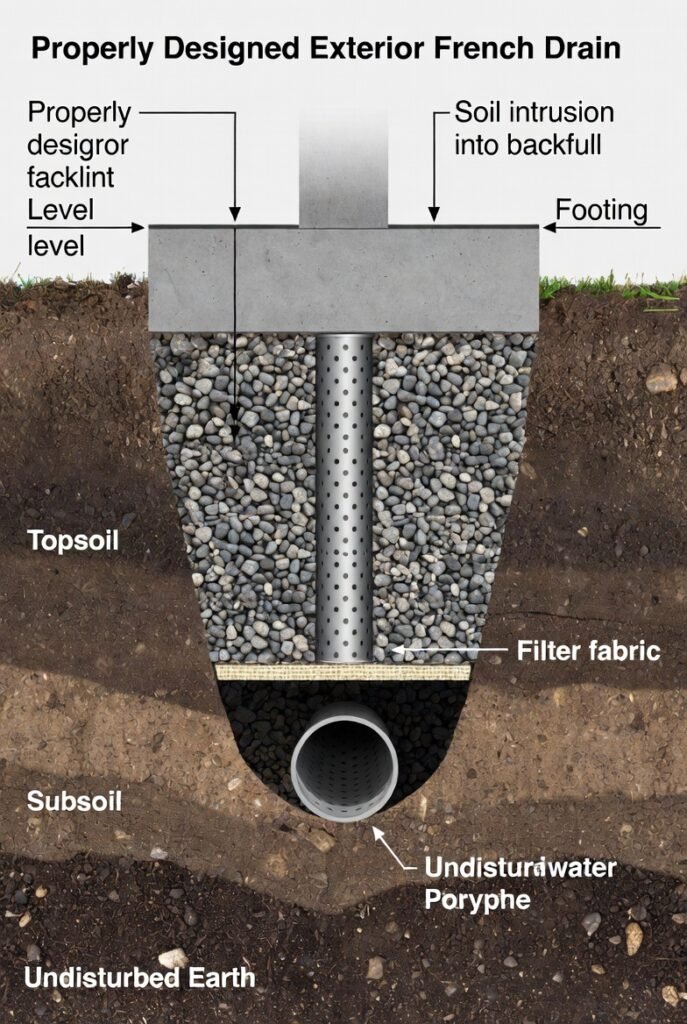
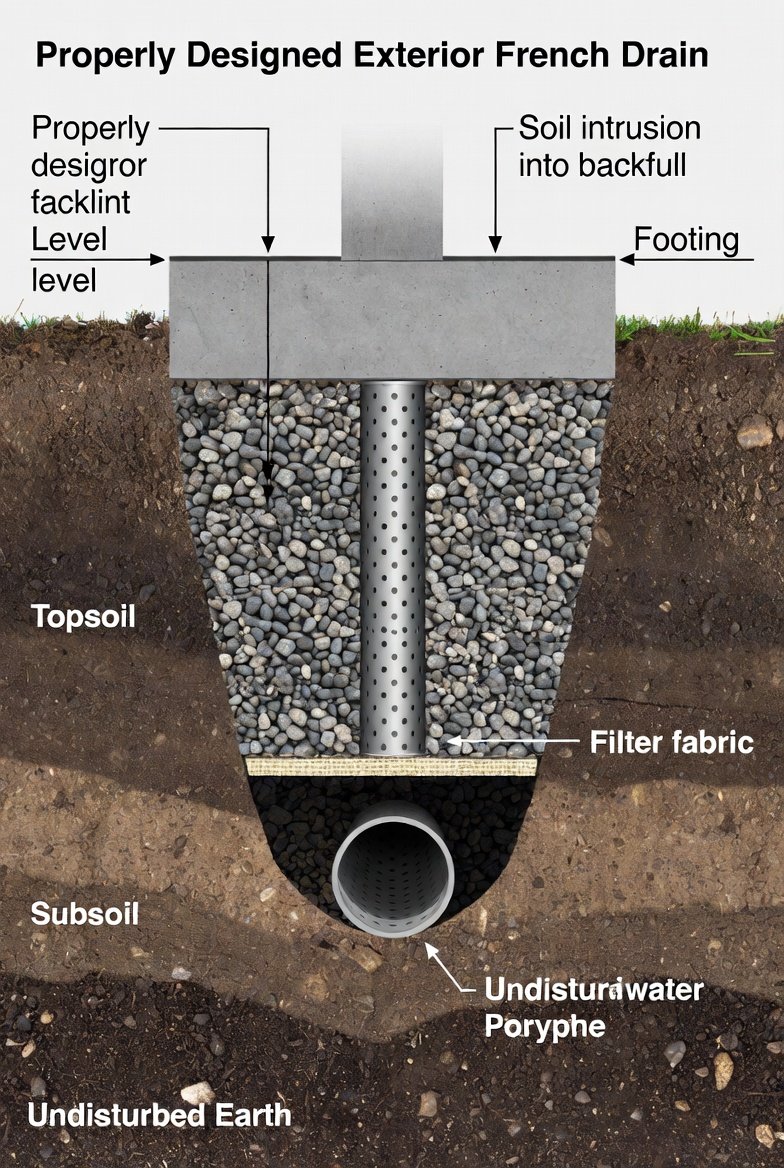
Exterior French Drain: Pressure Interception Before Wall Contact
Water does not damage a foundation because it touches it.
Damage happens when pressure builds and remains unrelieved.
When soil around a home becomes saturated, hydrostatic pressure pushes laterally against the wall and downward toward the footing. If no drainage path exists, water accumulates at the base of the wall and forces its way through porous block, cracks, or mortar joints.
An exterior French drain is installed to intercept groundwater at or below footing level, before sustained wall pressure develops.
It is a pre-wall interception system — not simply a trench filled with gravel.
For full system context:
Fast Definition
An exterior French drain is a gravel-lined trench with perforated pipe installed along the outside perimeter of a foundation at footing depth. It collects groundwater and redirects it away from the structure via gravity discharge (daylight) or sump integration.
It is often called a perimeter drain or footing drain.
Footing-Level Placement: The Most Important Detail
Exterior drains only reduce hydrostatic pressure if they are installed at the correct elevation.
The trench must:
- Extend to the bottom of the footing (or slightly below)
- Position the pipe at or below footing base
- Maintain continuous slope toward discharge
If the pipe sits above the bottom of the footing, groundwater remains beneath the foundation and pressure continues.
In stepped footings, drain elevation must adjust accordingly. Installing a single-level pipe across stepped sections can leave lower sections unprotected.
This elevation detail determines whether the system truly relieves pressure — or merely collects surface water.
Interior configuration reference:
interior french drain
How Exterior Systems Relieve Hydrostatic Pressure
Hydrostatic pressure increases when soil pores fill with water. That water pushes laterally against the wall.
Exterior drains interrupt this by:
- Creating a low-resistance gravel pathway
- Allowing groundwater to enter perforated pipe
- Redirecting water before it saturates wall surface
- Reducing sustained pressure load on foundation
Pressure reduction lowers seepage risk and reduces long-term crack propagation.
Exterior systems intercept water earlier in the water path than interior systems.
Waterproof Membrane & Drain Board Integration
Many exterior installations include additional protective layers:
- Waterproof membrane coating on foundation wall
- Drain board (dimple board) to create vertical water channel
- Protection board to prevent backfill damage
The drain pipe manages groundwater at the footing.
The membrane prevents wall penetration.
The drain board ensures vertical movement downward.
These layers are complementary — not interchangeable.
An exterior drain without wall protection may still reduce pressure but may not address porous block seepage.
Soil-Specific Design Logic
Soil type directly influences exterior system performance.
Soil Type | Behavior | Design Priority |
Clay | Holds water, low permeability | Heavy fabric separation |
Sandy | Drains quickly | Deeper interception |
Silty | Fine particles migrate | Aggressive filtration |
Rocky | Irregular bedding | Stabilized base layer |
Clay soils increase clogging risk.
Silty soils increase sediment infiltration risk.
Proper non-woven fabric separation is critical in clay-heavy environments.
Ignoring soil composition is one of the most common causes of premature system failure.
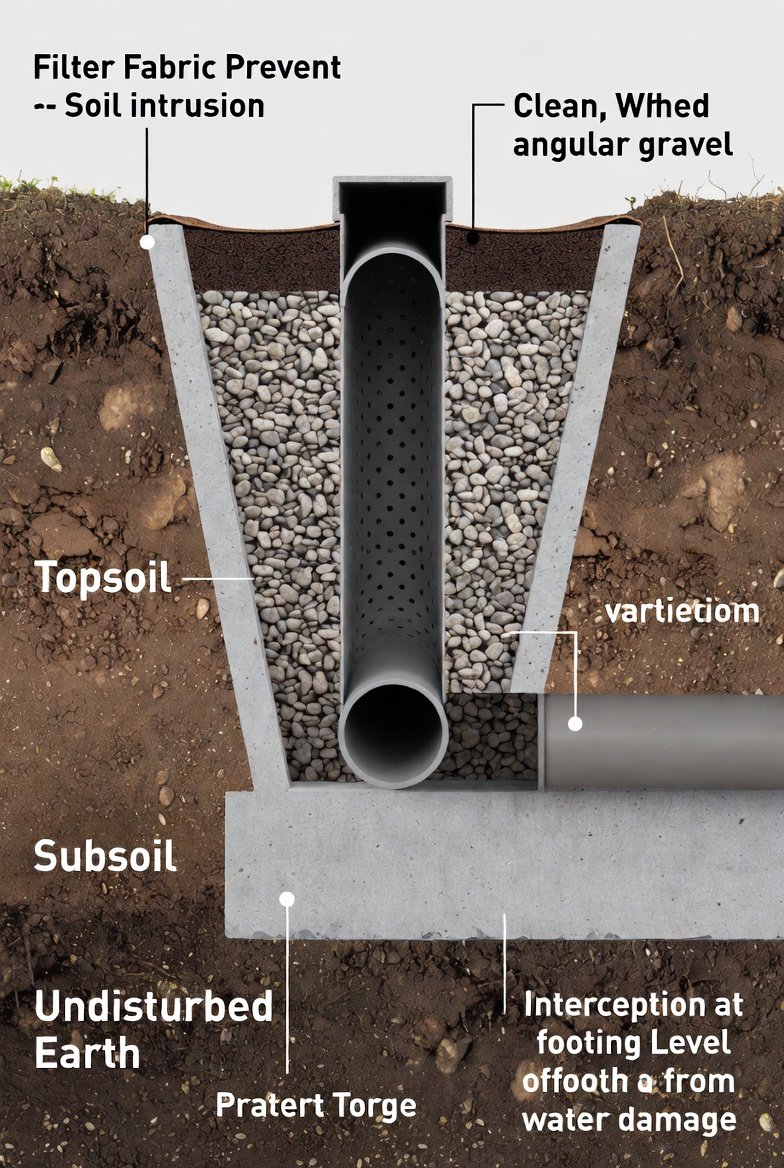
Discharge Engineering: Gravity vs Pump
An exterior drain must discharge effectively.
Daylight Discharge (Preferred When Possible)
- Gravity-based
- No mechanical dependency
- Requires consistent minimum 1% slope (≈ 1 inch per 8 feet)
- Outlet must remain above frost line and clear of debris
Long flat discharge runs increase clogging risk.
Sump Integration (When Slope Is Insufficient)
- Required on flat lots
- Requires basin sized for expected inflow
- Requires check valve
- Requires reliable discharge routing
Pump planning guidance:
basement-sump-pump-installation
Backup redundancy:
battery-backup-sump-pump-installation
Storm events frequently coincide with power outages. Redundant discharge reduces failure risk.
Excavation & Structural Caution
Exterior trenching occurs directly beside the foundation.
Improper excavation can:
- Undermine soil supporting the footing
- Destabilize backfill
- Create settlement zones
- Increase wall stress during trenching
Excavation should proceed in controlled sections, avoiding extended unsupported footing exposure.
Backfill must be compacted in lifts to prevent future grading reversal.
Exterior drainage performance depends as much on soil restoration as pipe placement.
When Exterior French Drain Is Structurally Appropriate
✔ New construction phase
✔ Major exterior renovation already underway
✔ Recurrent wall saturation
✔ High hydrostatic pressure environments
✔ Long-term foundation preservation priority
Exterior systems are strongest when interception happens early.
When Exterior Configuration May Not Be Ideal
✘ Tight urban lot lines
✘ Shared foundation walls
✘ Deep foundations exceeding safe trench depth
✘ Extensive landscaping disruption concerns
✘ Budget constraints favoring interior retrofit
In many retrofit homes, interior drainage is more practical.
Emergency seepage control:
water leak emergency
Common Exterior Failure Modes
Failure Mode | Cause | Result |
Pipe elevation error | Installed above footing | Continued pressure |
Sediment clogging | No proper fabric | Reduced flow |
Root intrusion | Tree proximity | Blocked pipe |
Frozen outlet | Improper slope | Backup flooding |
Settlement trench | Poor compaction | Surface water pooling |
Exterior drains fail most often due to improper installation — not material weakness.
Maintenance Checklist
Annually:
- Inspect discharge outlet
- Verify slope integrity
- Confirm no visible settlement
After heavy rainfall:
- Check pooling along wall
- Confirm outlet flow
Every few years:
- Inspect cleanout ports (if installed)
- Evaluate grading consistency
Exterior systems are low-maintenance but not maintenance-free.
Exterior vs Interior vs Layered Approach
Scenario | Recommended Approach |
New build | Exterior primary |
Retrofit urban basement | Interior |
Severe high water table | Exterior + interior |
Block wall seepage | Exterior + membrane |
Finished basement with limited access | Interior |
Exterior drains reduce pressure earlier.
Interior drains manage water at footing level.
Layered systems offer redundancy in high-risk environments.
What This Configuration Solves
An exterior French drain:
✔ Reduces sustained hydrostatic wall pressure
✔ Intercepts groundwater before wall contact
✔ Protects foundation from prolonged saturation
✔ Supports long-term structural durability
It does not:
✘ Repair structural cracks
✘ Correct poor grading
✘ Eliminate need for discharge planning
Clear understanding prevents misapplication.
FAQ
What is an exterior French drain?
A perimeter trench installed outside a foundation at footing depth to intercept groundwater and redirect it away from the structure.
How deep should it be installed?
At or slightly below footing level to effectively relieve hydrostatic pressure.
Is daylight discharge better than sump?
If natural slope exists, gravity discharge is preferred due to reduced mechanical dependency.
Do exterior drains require maintenance?
Yes. Outlets must be inspected and sediment buildup monitored.
Can exterior and interior drains work together?
Yes. In high-pressure environments, layered systems provide redundancy.
Does an exterior drain replace waterproof membrane?
No. The drain manages groundwater while membrane reduces wall penetration.