
Exterior Drainage System: How It Redirects Water Before It Reaches the Foundation
Introduction
Every spring, rainwater and melting snow collect in the soil around homes.
What begins as damp ground can quietly become foundation pressure weeks or months later.
Most basement water problems don’t start inside the basement.
They begin outside, in how water is handled around the structure.
An exterior drainage system exists for this early stage of the water path.
Its role is not to manage leaks or interior seepage, but to control surface and subsurface water before it ever reaches the foundation.
When this distinction is misunderstood, exterior drainage is often blamed for problems it was never designed to solve.
This guide explains:
- What an exterior drainage system actually does
- How it functions
- When it applies
- Where its responsibility clearly ends
What an Exterior Drainage System Actually Does for Your Basement
An exterior drainage system is a water-control network installed outside the structure, designed to collect and redirect water away from foundation walls.
In residential settings, exterior drainage may include:
- Perimeter footing drains along the foundation base
- Trench drains near grade
- Gravel-and-pipe drainage paths
- Surface runoff diversion channels
- Discharge routes that carry water away from the building envelope
All exterior drainage systems share one objective:
exterior foundation water management — reducing water contact and pressure before it becomes an interior problem.
What an Exterior Drainage System Is
(Structural Definition)
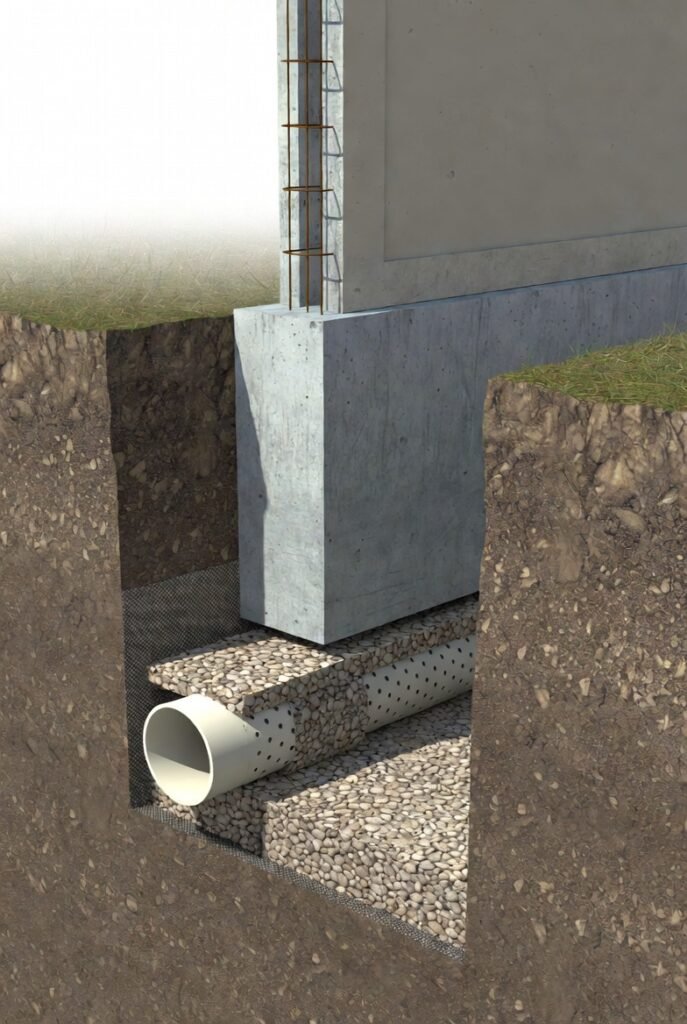
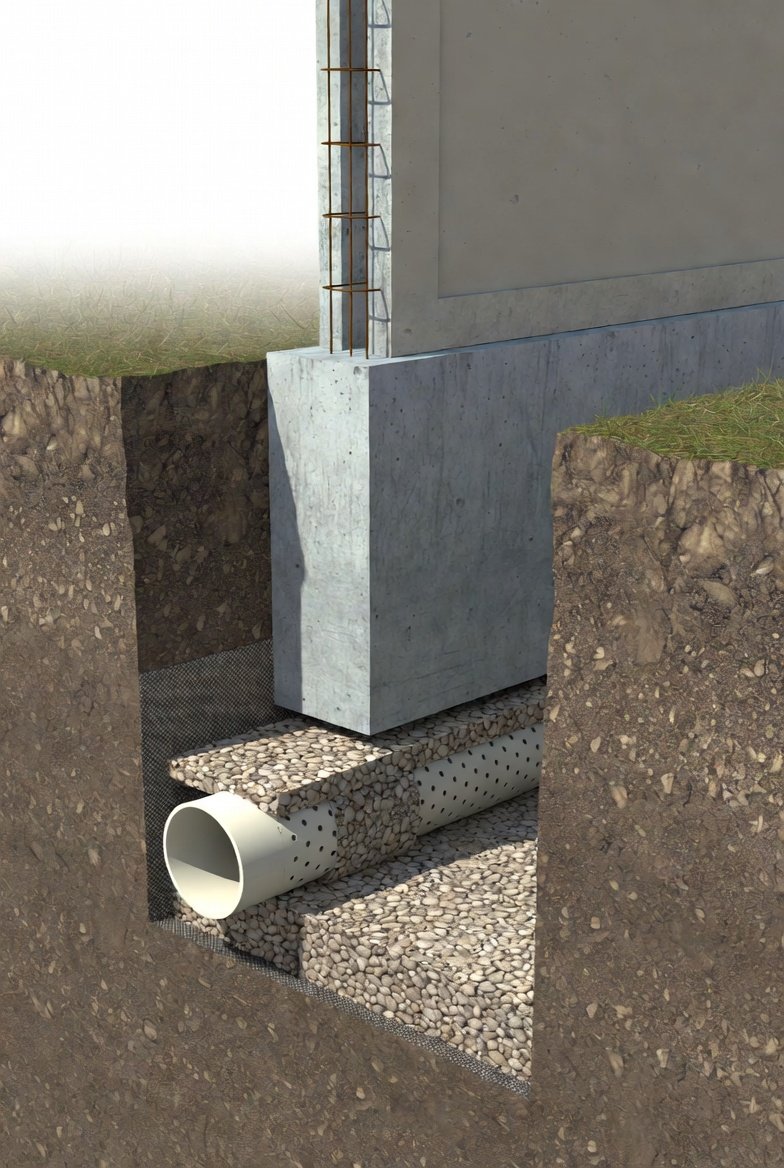
An exterior drainage system is a surface or subsurface collection and conveyance system installed outside a building, typically adjacent to foundation walls or at footing level.
A complete system often includes:
- A trench or excavation alongside the foundation
- Drainage stone that allows free water movement
- A perforated pipe or formed channel for collection
- A fabric layer to limit soil intrusion
- A discharge path that moves water downslope or away
Exterior drainage systems prevent hydrostatic pressure against the foundation, but they do not manage water once it has entered the basement.
Their role is interception, not interior control.
Why Your Foundation Needs Exterior Drainage
Foundations are exposed to water from multiple sources at once.
Common contributors include:
- Roof runoff concentrated near walls
- Poor surface grading
- Saturated soils after prolonged rain
- Seasonal groundwater rise
- Dense soils that retain moisture
When water remains in contact with foundation walls, pressure builds over time.
Exterior drainage shortens that contact window, lowering the chance that pressure will force water inward.
Rather than responding to leaks, exterior drainage focuses on preventive water control.
How Exterior Drainage Systems Work
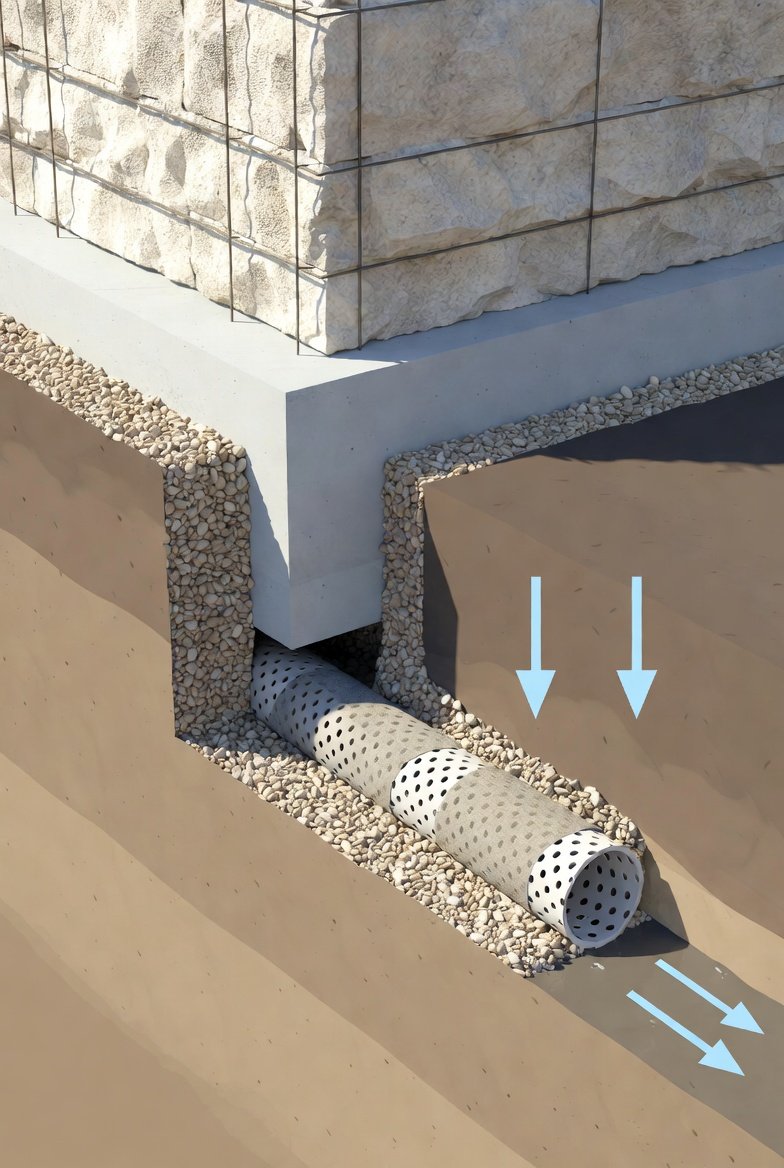
Exterior drainage follows a predictable sequence:
- Water accumulates at or near ground level
Rainfall, snowmelt, and irrigation increase surface and subsurface moisture. - Water moves toward the lowest-resistance path
Without control, that path is often the foundation wall. - The drainage system intercepts flow
Gravel beds and perforated pipes provide a preferred route. - Collected water is redirected away from the structure
Discharge paths move water downslope or to approved outlets. - Foundation contact and pressure are reduced
Less contact time means lower hydrostatic pressure.
Functionally, an exterior drainage system acts as a pressure-avoidance strategy, preventing buildup rather than relieving it later.
What Exterior Drainage Systems Do Well
Exterior drainage systems are best suited for surface-origin water problems.
They commonly help with:
- Water pooling near foundations after rain
- Persistent wet soil against foundation walls
- Runoff from roofs, patios, or hardscapes
- New construction or major exterior renovations
When aligned correctly, exterior drainage reduces the likelihood that water ever reaches the interior boundary.
What Exterior Drainage Systems Cannot Do
Exterior drainage has clear limits.
It does not:
- Manage water that has already entered the basement
- Control slab-edge seepage
- Seal foundation cracks or repair movement
- Eliminate interior humidity or condensation
- Address plumbing leaks or interior moisture sources
Exterior drainage reduces exposure, not interior release.
Once water reaches the slab edge, exterior drainage is no longer the controlling factor.
Exterior Drainage vs Interior Drainage
(Boundary Clarification)
Exterior and interior drainage systems operate at different stages of the water path.
- Exterior drainage reduces how much water reaches the foundation
- Interior drainage manages water after it arrives at the foundation zone
As explained in our Interior Drainage System guide, interior systems accept that pressure exists and focus on controlled release.
One lowers the load.
The other manages the release.
They are complementary, not interchangeable.
Why Exterior Drainage Systems Are Sometimes Seen as Ineffective
Most complaints stem from expectation mismatch, not system failure.
Common issues include:
- Surface grading still directing water toward walls
- Discharge paths allowing water to return
- Soil conditions that slow drainage movement
- Water entering from sources exterior drainage does not control
In these cases, the system may function correctly — but the overall water path remains incomplete.
Diagnostic Signals Exterior Drainage Is the Right Focus
When water problems originate outside the structure, these patterns often appear first:
- Water pools near the foundation after rain
- Soil remains damp against walls for extended periods
- Basement french drainage stays dry except during heavy storms
- Water staining appears higher on foundation walls
These signals suggest the issue begins before water reaches the basement.
Maintenance Reality for Exterior Drainage
Exterior drainage systems are largely passive, but long-term performance depends on:
- Clear discharge outlets
- Stable grading over time
- Avoiding landscaping that traps water near walls
Blocked or poorly routed discharge paths can undermine even well-designed systems.
When Exterior Drainage Is Secondary
Exterior drainage should not be treated as the primary response when:
- Water already enters at the slab edge
- Interior seepage appears without surface pooling
- Foundation movement is present
- Interior plumbing issues are confirmed
In these cases, exterior drainage may still contribute — but it is no longer the controlling mechanism.
Bottom Line
What an Exterior Drainage System Really Is
An exterior drainage system is preventive water-control infrastructure.
It:
- Does not waterproof basements
- Does not manage interior seepage
- Does not repair structures
It reduces the chance that water ever becomes a basement drainage problem by redirecting it before pressure builds.
Used at the correct stage of the water path, it is effective and
predictable.
Used after water has already entered, expectations break.