
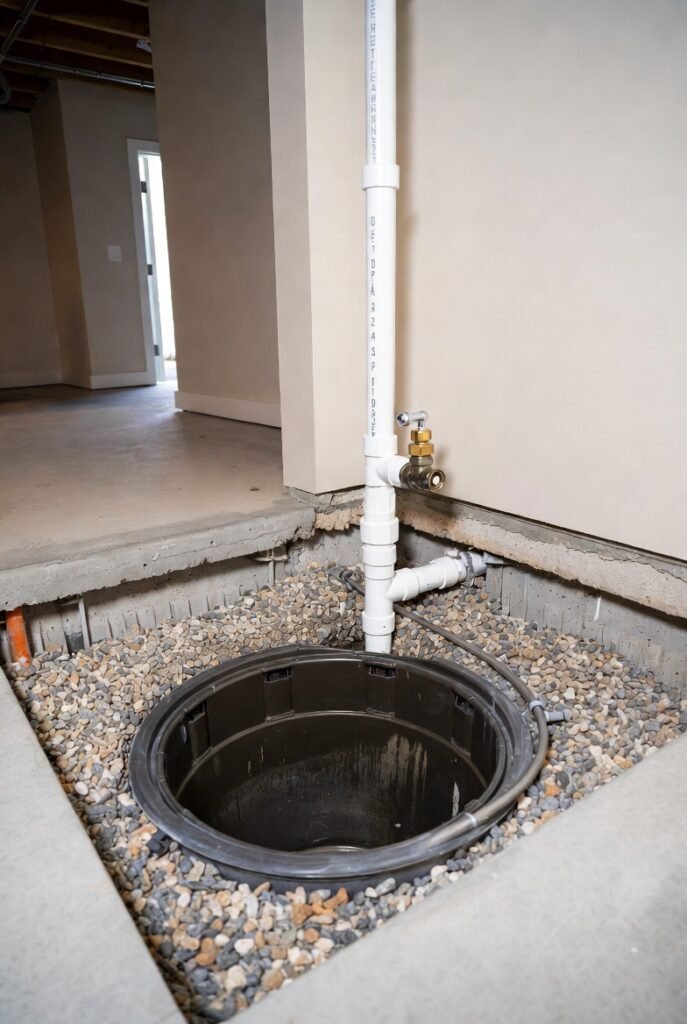
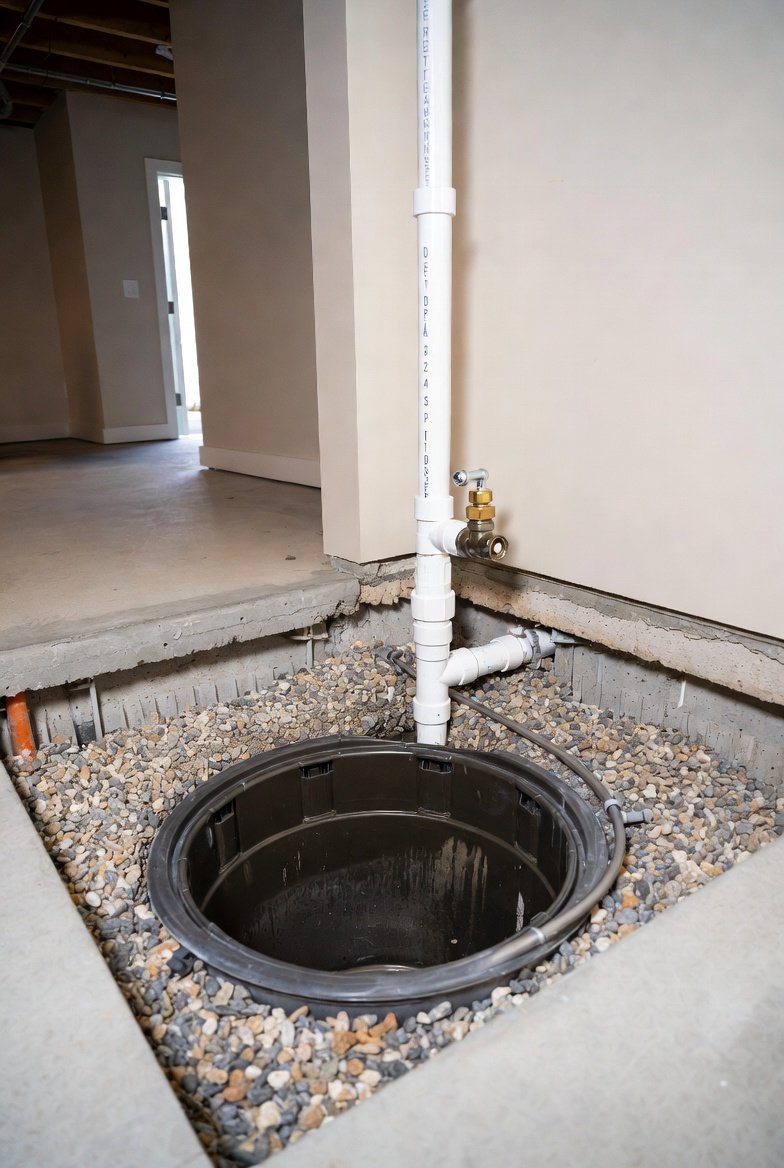
Basement Sump Pump Installation
A sump pump can be “working” and you can still end up with a wet basement.
That’s not bad luck. That’s usually a bad installation decision—wrong pit location, recycled discharge water, no check valve, or a setup that short-cycles itself to death.
This guide is built for basement reality (not generic plumbing theory). You’ll learn how to place the pit, build the basin correctly, route discharge so it doesn’t come right back, and understand what the job actually costs—especially when you’re cutting concrete.
If you’re reading this during an active water event, pause and start here first: water leak emergency (damage control comes before upgrades).
A Quick Reality Check Before You Cut Concrete
A sump pump is a groundwater control tool. It’s not a cure-all for every basement water problem.
Use this quick diagnosis:
- Water appears after heavy rain / snow melt → often groundwater/hydrostatic pressure (sump + drainage may help).
- Water is coming through the floor joint or from under the slab → sump system often makes sense.
- Water shows up from a pipe, water heater, appliance, or wall plumbing → fix the leak first (a sump won’t stop a supply line). Start with basement water leak and water leak repair
- Your basement is just damp/musty → you may need moisture control and air sealing in addition to pumping.
One clean way to think about it: a sump pump manages water you can’t easily stop from arriving (groundwater). Plumbing leaks are different.
What “Basement Sump Pump Installation” Actually Includes
A proper basement install typically means:
- Choose pit location (lowest point + practical routing)
- Cut the slab (clean cut, controlled demo)
- Excavate the pit (depth matters)
- Install basin + gravel base
- Set pump (float clearance + level)
- Install check valve
- Route discharge outside and away (no recycling)
- Seal the lid (humidity + soil gas control)
- Test and set a maintenance cadence
Building-science guidance emphasizes key requirements like check valves, directing discharge away from the building, and the value of an airtight sump cover for indoor air quality. (Source: Building America Solution Center, PNNL)
Step 1: Where to Place the Sump Pit in a Basement
The best sump pit location is the lowest practical point—but in a basement, you also have constraints that matter more than most DIY guides admit.
Basement placement rules that actually hold up
- Lowest hydraulic point: where water naturally wants to collect.
- Near an exterior wall: makes discharge routing simpler, shorter, and less leak-prone.
- Service access: you will service or replace the pump eventually—don’t bury your future self.
- Drainage tie-in awareness: if your basement has (or will have) an interior perimeter drain, the pit location should align with that system.
Operator note: Don’t choose a pit location just because it’s hidden behind storage. A “clean” location can be a “wrong” location.
If your overall basement system strategy isn’t clear yet, your umbrella hub should be your decision anchor: waterproofing systems (use it as the internal “owner” page).
Step 2: Cutting the Concrete Slab (The Part That Changes Everything)
This step is the main reason basement sump installs can be simple… or expensive.
What makes slab cutting risky
- Dust and debris (especially in finished basements)
- Slab cracking if the cut is sloppy
- Hidden surprises (odd slab thickness, reinforcement, tight access)
What a controlled cut looks like
- Outline the basin diameter (commonly 18–24 inches depending on basin size)
- Use a diamond blade to score and control cracking
- Break and remove concrete within the outline
- Excavate enough depth for: gravel base + basin + pump clearance
If you have a finished basement, the “cheap DIY” route can quickly turn into “expensive restoration.” In that case, hiring a pro can be the cheaper decision.
Step 3: Excavation Depth and Basin Setup (Where Bad Installs Start to Fail)
A sump basin isn’t just a container. It’s a controlled collection point.
What a stable basin needs
- Gravel base: improves inflow and stability
- Level basin: prevents float issues and vibration
- Clean backfill: supports water entry (especially if the basin is perforated)
Why gravel matters: It improves water movement to the basin and helps reduce clogging. Skipping it often leads to odd cycling behavior and early wear.
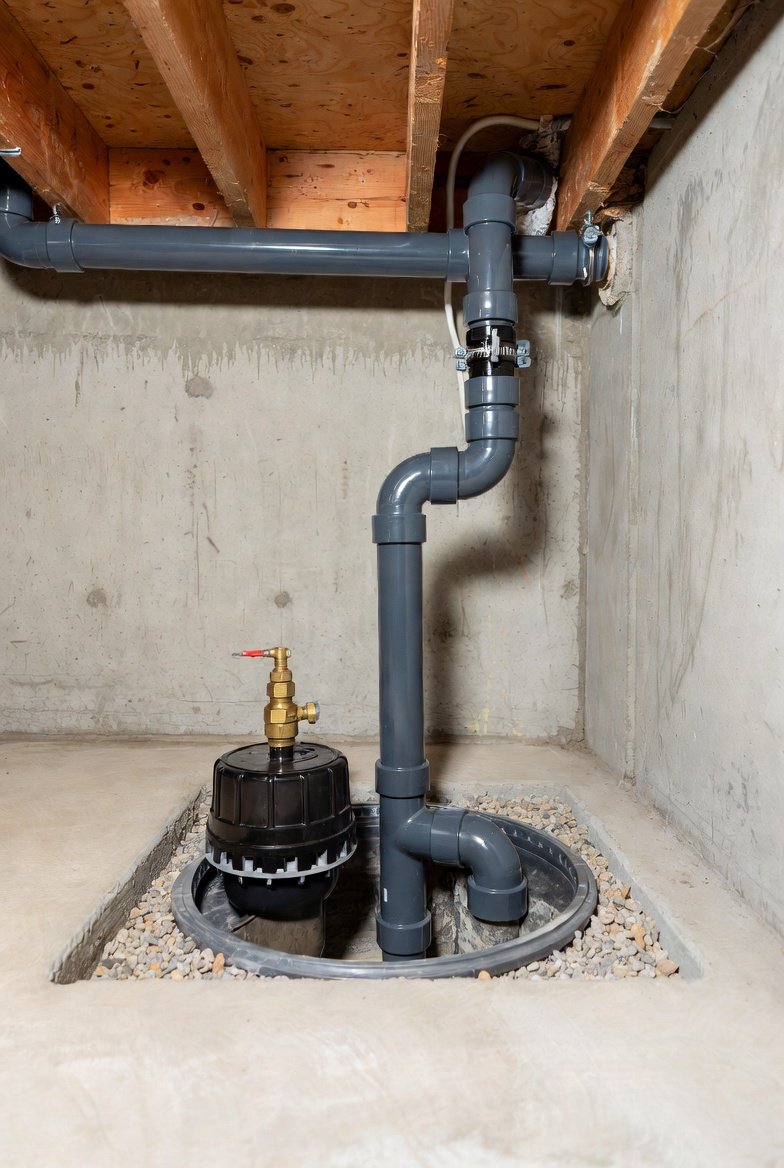
Step 4: Pump Selection and Installation (Basement Priorities)
Most homeowners choose between:
- Submersible pumps (quieter, sealed, sits inside basin)
- Pedestal pumps (motor above basin, louder, easier motor access)
For many basements, submersible is preferred because it’s quieter and cleaner.
Install checks that prevent “it ran but didn’t protect”
- Pump sits flat and stable (not on debris)
- Float switch moves freely (no wall interference)
- Discharge connection is tight and supported
If your basement already experiences heavy water events, you’ll likely also want to plan for redundancy later (backup systems). Your related money cluster pages should support this install article, including backup sump pump installation and battery backup pup sump installation
Step 5: Check Valve Installation (Non-Negotiable)
A check valve prevents pumped water from falling back into the basin after shutoff.
Without it:
- Water returns to the pit
- Pump cycles again
- Wear increases
- Failure happens sooner (usually during the storm you care about)
Building-science guidance specifically recommends installing a check valve to prevent backflow. (Source: Building America Solution Center, PNNL)
Step 6: Discharge Design (This Is the Real “Win or Lose” Section)
Most basement sump failures aren’t pump failures. They’re discharge failures.
A correct discharge line must:
- Exit the home cleanly
- Send water away from the foundation
- Drain properly between cycles (freeze prevention)
- Avoid low spots that hold water
The “recycling” failure (most common)
If discharge dumps close to the foundation, you saturate the soil next to the basement wall. Water re-enters the drainage zone and comes right back under the slab.
Guidance is clear: discharge should be directed out and away from the building. (Source: Building America Solution Center, PNNL)
Discharge checklist
- ✅ Termination point is well away from the foundation
- ✅ Pipe slopes so water drains out between cycles
- ✅ Joints are secured and supported
- ✅ No long flat runs that trap water
- ✅ In cold climates: plan for freeze risk
If you’re also trying to solve repeat water intrusion, connect this article with your broader system pages:
Those pages should clarify when the sump is the endpoint of a larger drainage strategy (not a standalone “magic fix”).
Step 7: Sealed Sump Lid (Basement Air Quality Upgrade Most People Skip)
A sealed lid is not just cosmetic.
An uncovered sump can allow moisture and soil gases to enter the home. Building science sources recommend an airtight sump cover to improve indoor air quality. (Source: Building America Solution Center, PNNL)
Basement-specific reasons sealed lids matter:
- Reduces basement humidity creep
- Keeps odors down
- Reduces soil gas entry (radon concerns vary by region)
- Keeps debris out (which protects the pump)
If you’re managing musty smell or mold risk, EPA guidance highlights moisture control as central to preventing mold. (Source: EPA mold & moisture guidance)
Cost: Basement Sump Pump Installation (Real Ranges + What Moves the Price)
Basement sump pump work is usually priced in two buckets:
1) Replacement (existing basin is already there)
You’re swapping a pump and maybe improving discharge/valves.
Typical range: $800 – $1,800 (varies by region and scope)
2) New install (cutting slab + digging pit + setting basin)
This is where the job becomes construction-like.
Typical range: $1,500 – $3,500 (unfinished basement)
Typical range: $2,500 – $6,000+ (finished basement, because restoration adds cost)
Consumer-facing cost references commonly show wide ranges for install because labor varies heavily by whether a basin exists and how discharge is routed. (Source: This Old House cost guide)
Cost multiplier table (why price jumps fast)
Factor | Why it increases cost |
Finished basement | Protection + demolition + restoration |
Thick slab / difficult cut | More time, tools, dust control |
Long or complex discharge route | More pipe, more joints, more labor |
Freeze-prone routing | Extra planning and components |
Drain tile tie-in | More system complexity |
Backup system add-on | Equipment + wiring + setup |
If you want the broader homeowner cost logic, pair this with:
- installation cost
- food cleanup cost(event-driven cost logic)
A Simple Decision Table: What You’re Seeing vs What Actually Fixes It
Symptom | Likely cause | Best next move |
Water rises at floor joint / under slab | Hydrostatic pressure | Sump + drainage strategy |
Water after heavy rain only | Exterior drainage issues | Grade/gutter fixes + evaluate sump |
Random puddles near appliances | Plumbing leak | Leak repair first |
Musty smell / dampness | Moisture load | Control humidity + inspect seepage |
Frequent sump cycling | Discharge recycling / high inflow | Fix discharge + check valve + pit inflow |
For leak-source clarity before investing in systems, your diagnostic hub should support this page: leak detections services
Testing and Maintenance (The 5-Minute Routine That Prevents Surprise Failures)
Quarterly test:
- Pour water into the pit until the float triggers
- Confirm the pump starts and runs smoothly
- Watch discharge outside (verify flow)
- Confirm pump shuts off cleanly and check valve closes
Red flags:
- Loud rattling/vibration
- Runs but discharge is weak
- Short-cycles repeatedly
- Pit fills faster than it can pump out
A simple habit beats an expensive emergency.
Limitations: When This Advice Doesn’t Apply
- If your basement water is from pressurized plumbing leaks, a sump won’t fix it—repair the leak first. Start with water leak repair
- If water intrusion is widespread and you have no drainage strategy, the sump may be only one part of the system solution.
- If you have radon mitigation or suspected radon issues, sealing the pit and coordinating components becomes more important (basement conditions vary).
When to Call a Pro (The Honest Line)
Call a pro if:
- Your basement is finished
- You need to tie into an interior drainage system
- You can’t route discharge correctly without long runs and complex exits
- Flooding is recurring and you don’t fully understand the water source
If you want the emergency-playbook version for active events, keep this nearby: water leak emergency
Final Verdict
A basement sump pump can be a solid protection system—but only when the installation is engineered as a system:
- Correct pit location
- Stable basin + gravel base
- Check valve installed properly
- Discharge routed out and away (no recycling)
- Sealed lid for basement air and moisture control
- Testing routine so you’re not surprised later
Do it right once, and it quietly protects you for years.