
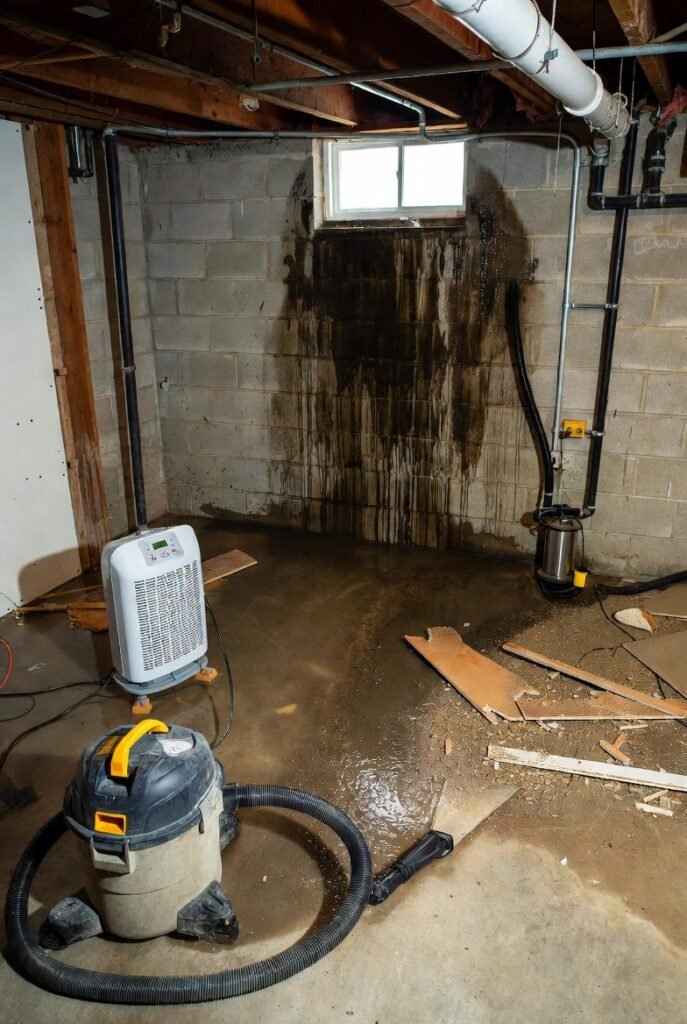
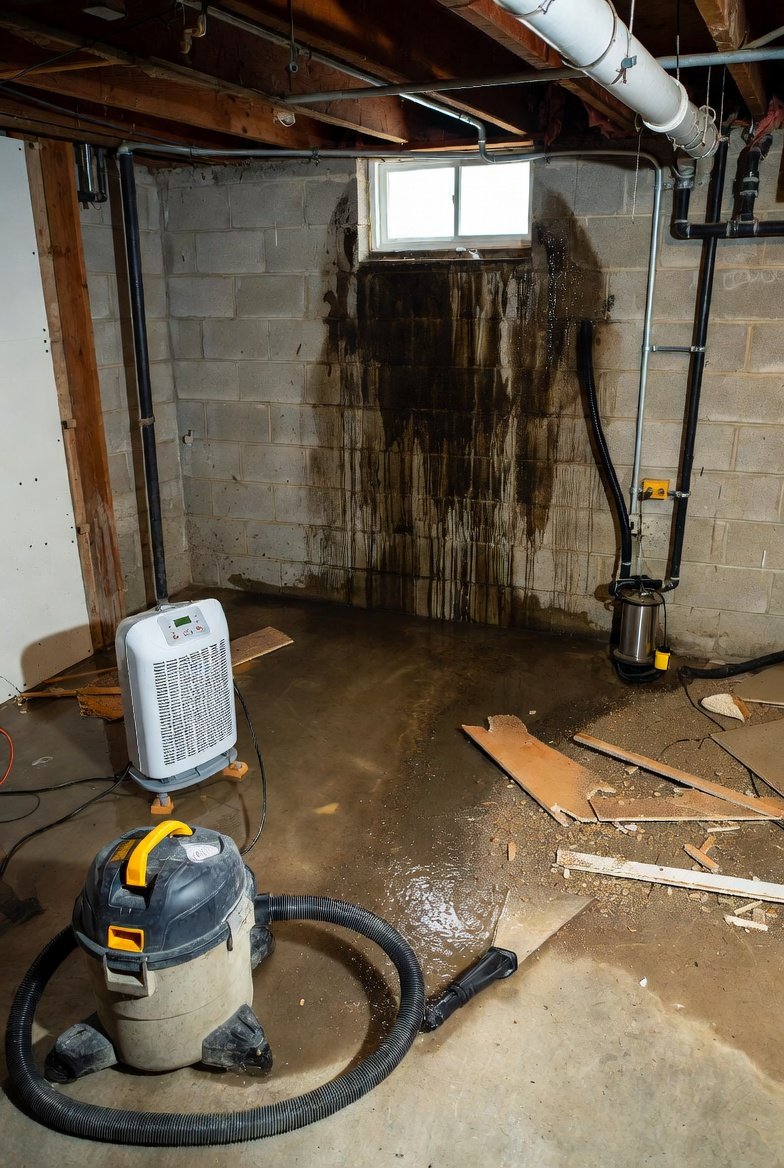
Basement Water Cleanup: What Professional Service Actually Includes
Basement water cleanup is not “pump it out and run a fan.”
A proper cleanup is a controlled, measured process designed to prevent three expensive outcomes:
- Hidden moisture that causes odor and mold
- Material decay (subfloors, framing, drywall)
- Repeat water events caused by the same failure point
Most homeowners don’t need a sales pitch. They need clarity.
This guide explains:
- What real professional service includes
- When DIY is safe and when it is not
- What makes jobs escalate
- What “done correctly” looks like
- How to prevent the next flood after cleanup
If you’re in an active emergency moment, use the immediate safety guide first:
Before Anything Else: Safety Gate
Do not enter the basement until you’ve checked the high-risk variables.
High-risk conditions where you should pause and get help:
- Electrical risk: water near outlets, cords, appliances, or panels
- Unknown contamination: sewage smell, toilet overflow, drain backup
- Structural warning signs: fresh wall movement, widening cracks, buckling floors
- Deep or fast-rising water
If any of those are present, treat the situation as a service event first—cleanup second.
For broader context on why flooding happens (and why it repeats), see:
What Professional Basement Water Cleanup Includes
A legitimate service normally runs in clear phases. If a provider skips one, the risk of future mold and odor increases.
1) Stop the Source and Stabilize the Space
Pros don’t begin by “drying.” They begin by controlling the cause.
They confirm whether the source is:
- Plumbing leak (supply/drain line)
- Surface runoff (grading/downspouts)
- Groundwater pressure (hydrostatic)
- Sump/discharge failure
If the event is tied to sump failure, these pages become relevant immediately:
basement-sump-pump-installation
battery-backup-sump-pump-installation
2) Water Extraction (Visible Water Removal)
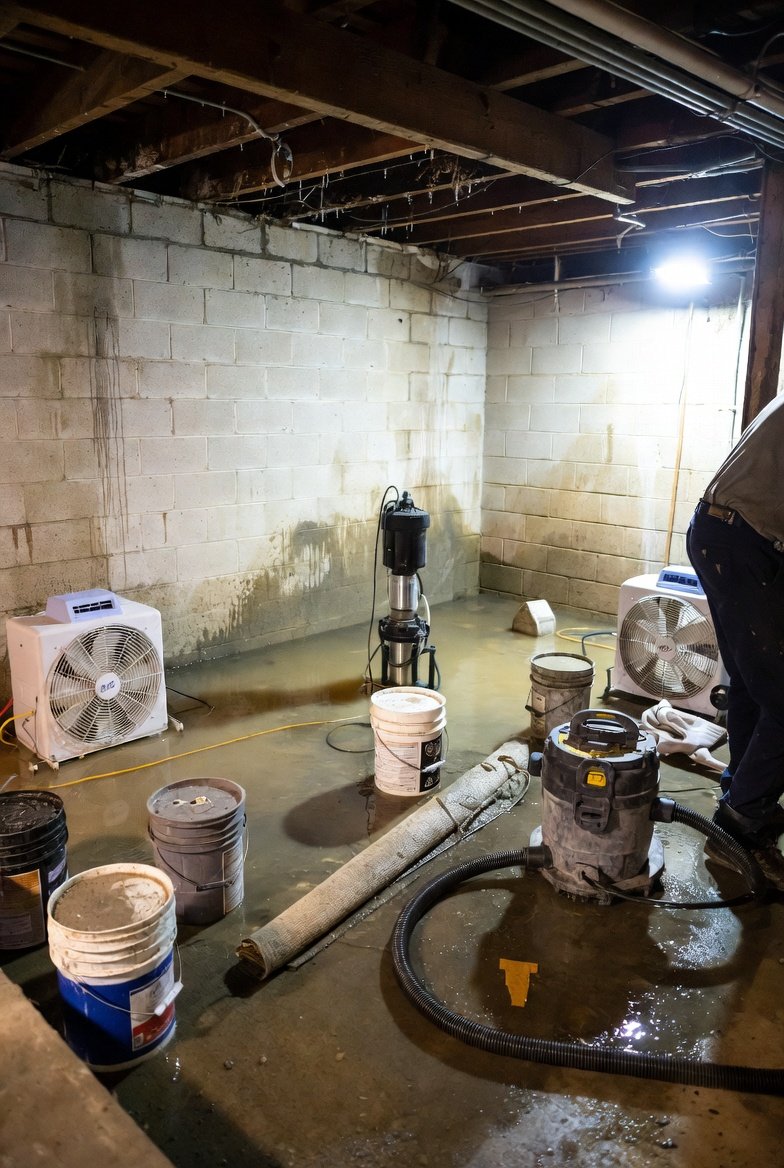
Professionals typically use:
- Submersible pumps for standing water
- Commercial extraction tools for floors and carpets
- Wet vac systems for localized areas
Why this matters: the faster standing water is removed, the less it migrates into wall cavities and under flooring.
3) Moisture Mapping (The Step DIY Usually Misses)
This is the difference between “looks dry” and is dry.
Pros map moisture with:
- Moisture meters (wood/drywall readings)
- Hygrometers (humidity/dew point conditions)
- Sometimes infrared scanning to identify cold/wet zones
Hidden moisture commonly sits:
- Under finished flooring (LVP, laminate, carpet padding)
- In baseboards and drywall bottoms
- Behind insulation in exterior walls
- In rim joists and sill plates
If moisture is not mapped and tracked, the job becomes guesswork—and guesswork is how mold starts.
4) Structural Drying (Air Movers + Dehumidifiers, Not Just Fans)
Drying is a controlled environment, not “airflow.”
A proper drying setup usually includes:
- High-velocity air movers to keep evaporation steady
- Dehumidifiers to remove moisture from the air
- Strategic placement (not random fan placement)
Typical drying time: 2–5 days depending on materials, temperature, and saturation.
Drying should be monitored and adjusted. A real service checks progress and changes equipment positioning as needed.
5) Cleaning, Sanitizing, and Containment (Especially for Dirty Water)
Water category changes everything.
If contamination is suspected, pros may use:
- Antimicrobial treatments on affected surfaces
- HEPA filtration (air scrubbing) to control airborne particles
- Containment (plastic barriers) when demolition is required
Sewage or drain backup requires biohazard protocols and usually removal of porous materials that cannot be reliably disinfected.
For cost realism (without turning this page into a cost anchor), reference:
6) Controlled Demo and Restoration Planning (Only When Required)
In finished basements, the job often escalates from “cleanup” to “restore.”
Common removals include:
- Carpet padding
- Saturated drywall and insulation
- Swollen trim and baseboards
- Warped subfloor layers
The goal is not demolition—it’s preventing trapped moisture from becoming a long-term indoor air problem.
Scope Triggers: When a “Simple Cleanup” Becomes a Bigger Job
This is the part most SERP pages fail to explain clearly.
Your cleanup scope usually expands if:
- Water touched drywall (especially the bottom 12–24 inches)
- Carpet padding is saturated (padding holds water aggressively)
- Water sat longer than 24–48 hours
- The basement is fully finished (more hidden cavities)
- Sewage or grey water is involved
- Moisture migrated under hard flooring or into wall cavities
These triggers matter because they change what “done right” requires.
DIY vs Professional Service Decision Rules
This is the cleanest decision gate for homeowners.
Situation | DIY Acceptable | Hybrid Possible | Pro Service Recommended |
Clean water on bare slab, caught fast | ✅ | ||
Small localized leak, no drywall wet | ✅ | ✅ | |
Water reached drywall or insulation | ✅ | ||
Water sat 24–48 hours | ✅ | ✅ | |
Finished basement, widespread wet area | ✅ | ||
Sewage/backup involved | ✅ |
If you’re uncertain about contamination, assume it’s contaminated until verified.
What Can Go Wrong (Failure Modes of Bad Cleanup)
A good service prevents problems you don’t see today.
Common failure modes:
- Drying without moisture mapping → hidden wet zones remain
- Sealing or repainting too early → moisture is trapped
- Under-floor moisture ignored → odor, warping, microbial growth
- Wrong dehumidification strategy → humidity remains high for days
- No documentation → insurance disputes and “he said/she said” scope fights
If a cleanup fails, you don’t just get mold—you get repeat work, higher costs, and longer downtime.
Timeline: What Should Happen in the First 48 Hours
Time Window | What Should Be Happening |
0–2 hours | Confirm source, establish safety, stop inflow |
2–6 hours | Remove standing water, pull saturated loose items |
6–24 hours | Start controlled drying, map moisture zones |
24–48 hours | Re-check readings, decide on selective demo if needed |
Time matters because the longer moisture remains, the more likely you’ll need material removal.
Insurance Documentation Checklist
If insurance may be involved, documentation makes cleanup smoother.
Capture:
- Photos/videos of affected areas and water depth
- Source (pipe, drain backup, runoff)
- Timeline (when discovered, when stopped)
- Items damaged (flooring, drywall, furniture)
- Any visible contamination indicators
For long-term prevention costs (separate page type), see:
After Cleanup: How to Prevent Repeat Events
Cleanup fixes damage. It does not fix recurrence.
If this is not your first water event, you should evaluate the drainage system stack:
- Surface water control
- Interior/exterior drains
- Sump capacity and discharge reliability
- Backup power and alarms
Start with the system overview:
If the issue is perimeter pressure and you’re comparing configurations:
- Exterior:
- exterior-french-drain
- Interior:
- interior-french-drain
Maintenance and Lifecycle Reality (So You Don’t Get Surprised Again)
Even good systems fail if ignored.
Simple maintenance routines that prevent repeat cleanup calls:
- Test sump pump function quarterly
- Inspect discharge line before winter (freeze risk)
- Clean gutters and confirm downspout routing twice per year
- Re-check grading after landscaping or settling
- Keep a humidity monitor in finished basements during wet seasons
This is not “extra.” It is the difference between one event and recurring damage.
FAQ
What is basement water cleanup?
Basement water cleanup is the process of extracting water, mapping hidden moisture, drying structural materials, sanitizing affected areas, and restoring damaged finishes when necessary.
How long does professional basement drying take?
Most drying cycles take 2–5 days, depending on saturation, materials, and humidity conditions.
When should I call a professional instead of doing it myself?
Call for service if water reached drywall, contamination is possible, the basement is finished, or the water sat longer than 24 hours.
Is it safe to use fans and open windows?
Fans can help airflow, but without dehumidification and moisture tracking, you can leave hidden wet zones behind—especially under floors and in wall cavities.
What equipment do pros use for basement water cleanup?
Common tools include submersible pumps, commercial extractors, air movers, dehumidifiers, moisture meters, and sometimes infrared scanning.
Do I always need to remove drywall after a flood?
Not always. Drywall removal depends on how far saturation climbed, how long water sat, and whether contamination is involved.
What if the water is from a drain backup or sewage?
Sewage events typically require biohazard protocols and removal of porous materials that cannot be reliably disinfected.
How do I know if moisture is trapped behind walls or under floors?
Moisture mapping tools (meters/hygrometers) confirm hidden wet zones. Visual dryness is not reliable.
Does cleanup prevent future basement flooding?
Cleanup prevents mold and material decay after an event. Preventing future flooding requires addressing drainage and system failures.
How should I document damage for insurance?
Take photos/videos of water depth and affected materials, record the timeline, note the suspected source, and save receipts for any mitigation steps.
Can I stay in the home during drying?
Often yes for clean-water events, but if contamination or extensive demolition is involved, it depends on containment and air quality controls.
What’s the best next step if my basement has flooded more than once?
Treat it as a recurrence issue and evaluate the drainage system stack, sump reliability, and pressure management.